Michael AndersonCompliance Research & Editorial ReviewerAugust 25, 2026
What are the Texas fire inspection requirements for businesses?
Texas fire inspection requirements for businesses are not uniform statewide; they are primarily determined by local Authority Having Jurisdiction (AHJ), typically municipal fire departments, which adopt and amend codes like the International Fire Code (IFC) or NFPA standards. Businesses must comply with local ordinances covering extinguishers, egress, alarm systems, hazardous materials, and kitchen suppression, with specific fees and renewal schedules varying significantly by city.
Key Takeaways
Texas fire inspection requirements are localized, not statewide, with each municipality (AHJ) adopting and amending its own fire codes.
Core inspection components include fire extinguishers, clear egress routes, functional alarm and suppression systems, hazardous material handling, and electrical safety.
Permit fees, inspection frequencies, and renewal schedules vary drastically by city (e.g., Houston, Dallas, Austin), necessitating specific, verified local data.
Outdated online information is a significant risk; businesses need current, city-specific fee schedules and ordinances to avoid compliance failures.
Proactive measures like employee training, regular maintenance, and a comprehensive Emergency Action Plan are critical for continuous safety beyond inspections.
Understanding Texas fire inspection requirements for businesses is critical for operational continuity and safety, yet it is a nuanced landscape primarily governed by local municipal fire departments rather than a single statewide mandate. A business fire inspection is a regulatory assessment conducted by the local Authority Having Jurisdiction (AHJ) to ensure that commercial properties comply with fire safety codes and standards, safeguarding occupants and property from fire hazards. While general safety principles apply, the specific codes, permit fees, inspection frequencies, and enforcement practices diverge significantly from city to city, often catching unprepared business owners off guard. As Michael Anderson, Compliance Research & Editorial Reviewer for Commercial Compliance Hub, emphasizes, accurate and current local data is paramount, given that permit fees and processes can change without public announcement, rendering general advice quickly obsolete.
The Texas Fire Code Labyrinth: Why "Statewide" Doesn't Apply to Your Business
Many business owners mistakenly assume a uniform set of Texas fire inspection requirements for businesses exists across the state. This assumption is a significant compliance pitfall, leading to unexpected penalties and operational delays. The reality is that fire safety regulations in Texas are overwhelmingly decentralized, with local municipalities acting as the primary authorities. This means that a coffee shop in Austin faces different requirements, fee structures, and even adopted code editions than an identical coffee shop just a few miles away in Round Rock or an auto repair shop in Houston.
The term "Authority Having Jurisdiction" (AHJ) is crucial here. An AHJ is an organization, office, or individual responsible for enforcing the requirements of a code or standard, or for approving equipment, materials, an installation, or a procedure. In Texas, the AHJ for fire safety is typically the local fire department or municipal fire marshal's office. These local entities have the power to adopt, amend, and enforce specific fire codes that may vary substantially from their neighboring jurisdictions (Source: Texas Local Government Code, Chapter 342, 2023).
This jurisdictional fragmentation creates a compliance labyrinth. For businesses operating multiple locations across Texas, or those expanding into new cities, a "one-size-fits-all" approach to fire safety is not only ineffective but also dangerous. What might be compliant in Dallas could be a violation in Fort Worth. This critical divergence is often overlooked by general online guides, which fail to provide the granular, city-specific detail that operations managers and business owners desperately need to maintain continuous compliance.
The impact on multi-location businesses is particularly acute. A director of operations overseeing 20 to 400 records across various sites cannot rely on a single checklist. Each location demands a bespoke understanding of its local fire code, permit requirements, and inspection schedules. Failure to recognize this jurisdictional trap can result in costly fines, revoked permits, or even temporary closures, directly impacting revenue and reputation. Commercial Compliance Hub specializes in dissecting these local variations, providing verified, city-specific data to overcome this challenge.
Understanding Local Fire Jurisdiction and Code Adoption
To effectively navigate Texas fire inspection requirements for businesses, one must first grasp how local jurisdictions establish and enforce their fire codes. This involves understanding the role of the local fire marshal, the prevalent code frameworks, and the process of local amendments.
The Role of the Fire Marshal's Office
Each municipality in Texas typically has a Fire Marshal's Office or a division within its fire department dedicated to fire prevention and code enforcement. This office is responsible for conducting inspections, issuing permits, investigating fires, and educating the public on fire safety. They are the primary point of contact for businesses seeking to understand and comply with local fire codes. Their authority extends to approving building plans, overseeing fire protection system installations, and ensuring ongoing compliance through regular inspections.
The Fire Marshal's Office also plays a critical role in interpreting the adopted fire codes. While the codes themselves are often complex legal documents, the local AHJ provides guidance on their application to specific business types and property configurations. Engaging with your local Fire Marshal's Office early in the planning stages of a new business or renovation can save significant time and resources.
Common Code Frameworks: NFPA and ICC
Texas cities predominantly adopt fire codes based on two major national frameworks: the National Fire Protection Association (NFPA) standards and the International Fire Code (IFC) published by the International Code Council (ICC). Both are comprehensive sets of regulations designed to minimize fire risks, but they have distinct structures and emphases.
The NFPA, a global non-profit organization, develops codes and standards aimed at preventing fire, electrical, and related hazards. Its most widely adopted standard for life safety is NFPA 101, often referred to as the Life Safety Code. This code focuses on protecting building occupants from fire and similar emergencies, emphasizing means of egress, fire protection features, and building services. Many Texas cities, particularly larger ones, integrate aspects of NFPA standards into their local ordinances.
The International Fire Code (IFC) provides comprehensive fire safety regulations for new and existing buildings, covering everything from fire department access and fire protection systems to hazardous materials storage and occupant safety. It is often adopted as part of a larger family of International Codes (e.g., International Building Code, International Plumbing Code). The IFC is widely adopted across the United States, including a significant number of Texas municipalities (Source: ICC Code Adoption Map, 2024).
It is important to note that while cities adopt these national codes, they often do so with specific editions (e.g., 2018 IFC vs. 2021 IFC) and, crucially, with local amendments. This means even if two Texas cities both adopt the IFC, their specific requirements can still differ based on the adopted edition and local modifications.
City-Specific Amendments and Local Ordinances
The true complexity of Texas fire inspection requirements for businesses lies in the power of local jurisdictions to amend adopted national codes. These amendments are often driven by local environmental factors, historical fire incidents, unique urban development patterns, or specific community priorities. For example, a city might require higher fire resistance ratings for buildings in its historic district or mandate specific types of fire suppression systems for certain industrial zones.
These local ordinances can add, delete, or modify sections of the base code, creating a unique regulatory landscape for each city. For instance, while the IFC might specify general requirements for fire alarms, a local ordinance could mandate a specific type of alarm system or a more frequent testing schedule for particular occupancy types. This makes generic compliance advice largely unhelpful; a business owner needs to consult the specific municipal code and amendments for their operating city.
Understanding these amendments requires direct engagement with the local Fire Marshal's Office or meticulous review of published municipal codes. Commercial Compliance Hub provides verified access to these specific local amendments, ensuring businesses have the exact, current information needed to comply.
Core Components of Texas fire inspection requirements for businesses
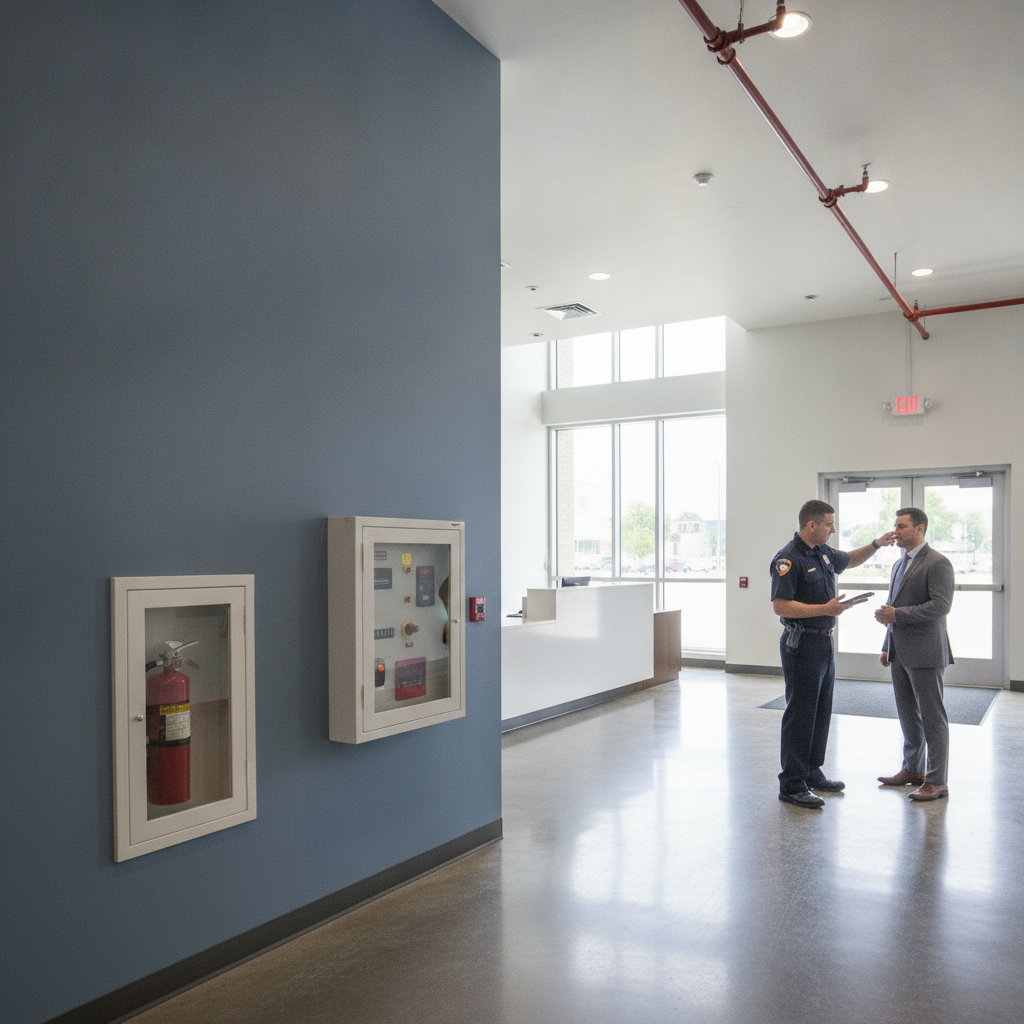
Despite the jurisdictional variations, certain fundamental elements are universally scrutinized during Texas fire inspection requirements for businesses. These core components form the backbone of fire safety and are designed to prevent fires, facilitate safe evacuation, and enable effective firefighting operations. Understanding these areas is the first step toward preparing for any inspection.
Fire Extinguishers: Placement and Maintenance
Portable fire extinguishers are a primary line of defense against small fires and are a mandatory item for nearly all businesses. Inspectors will verify several key aspects: proper type (e.g., ABC for general use, K for kitchen fires), correct placement (easily accessible, clear visibility, mounted at appropriate height), and adequate quantity based on occupancy and hazard levels. Crucially, they will check for valid inspection tags, ensuring annual professional servicing and monthly visual inspections are up-to-date. Failure to maintain extinguishers or place them correctly is a common violation.
Exit Access and Egress Routes
Ensuring clear and unobstructed exit routes is paramount for life safety. Inspectors meticulously check all exit doors, exit signs, and emergency lighting. Exit doors must swing freely in the direction of egress, be unlocked from the inside, and not be blocked by storage or debris. Exit signs must be illuminated and clearly visible. Emergency lighting systems must be functional, automatically activating during power outages to guide occupants to safety. The path to exits, including hallways and aisles, must remain clear and wide enough to accommodate the building's occupant load. Any obstruction, even temporary, constitutes a serious violation (Source: NFPA 101, Chapter 7, 2022 Edition).
Fire Alarm and Detection Systems
For many commercial occupancies, especially those with higher occupant loads or specific hazards, fire alarm and detection systems are mandatory. Inspectors will verify the functionality of smoke detectors, heat detectors, manual pull stations, and alarm horns/strobes. They will also review maintenance records to ensure systems are regularly tested and inspected by qualified personnel, typically on an annual basis. Tampering with or disabling these systems is a severe offense that can lead to immediate penalties.
Sprinkler and Suppression Systems
Buildings equipped with automatic fire sprinkler systems or other specialized suppression systems (e.g., clean agent systems for data centers) will undergo thorough inspection. The AHJ will verify that the system is properly maintained, free of obstructions, and has current inspection, testing, and maintenance (ITM) records. This includes checking sprinkler heads for damage or paint, ensuring proper water pressure, and verifying that control valves are open and accessible. Like alarms, these systems require professional annual inspections and periodic testing.
Hazardous Materials Storage and Handling
Businesses that store or use hazardous materials, such as chemicals, flammable liquids, or compressed gases (e.g., auto repair shops, salons, certain manufacturing facilities), face specific and stringent requirements. Inspectors will assess storage containers, ventilation systems, spill containment measures, and appropriate signage. They will also verify that safety data sheets (SDS) are readily available for all hazardous materials and that employees are trained in their safe handling and emergency procedures. Compliance in this area is complex and often requires specialized permits.
Electrical Safety and Equipment Maintenance
Faulty electrical systems are a leading cause of commercial fires. Inspectors will look for overloaded circuits, frayed wiring, improper use of extension cords (which should not be used as permanent wiring), and unapproved electrical modifications. They will also check for clear access to electrical panels and proper labeling. All electrical equipment should be used and maintained according to manufacturer specifications and relevant codes to prevent overheating and short circuits.
Kitchen Hood Suppression Systems (for Food Service)
For restaurants, cafes, and any business with commercial cooking operations, kitchen hood suppression systems are a critical focus. These systems are designed to automatically detect and extinguish fires in cooking appliances and exhaust hoods. Inspectors will verify that the system is properly serviced and tagged by a certified professional, typically every six months (Source: NFPA 96, 2021 Edition). They will also check for proper clearance from cooking equipment, ensure adequate ventilation, and confirm the presence of accessible manual activation points.
Occupancy Limits and Layout Compliance
The maximum number of people allowed in a space, known as the occupancy limit, is determined by the building's design and egress capacity. Inspectors will ensure that businesses are not exceeding these limits and that the layout of furniture, fixtures, and displays does not impede exit pathways or create undue congestion. Changes to floor plans or significant increases in occupant load often require review and approval by the Fire Marshal's Office to ensure continued compliance.
The Inspection Process: What to Expect and How to Prepare
Navigating the actual fire inspection process requires preparation and an understanding of local procedures. While the specifics of Texas fire inspection requirements for businesses vary by municipality, the general flow of an inspection and the expectations of the AHJ remain consistent.
Frequency and Types of Inspections
The frequency of fire inspections for businesses in Texas is determined by the local AHJ, often based on the occupancy classification and perceived risk level of the business. High-risk occupancies like restaurants, childcare centers, and assembly spaces (e.g., fitness studios, event venues) typically receive annual inspections. Lower-risk occupancies, such as general retail or office spaces, might be inspected less frequently, perhaps every two to three years. There are generally two types: scheduled inspections, where businesses are notified in advance, and unscheduled inspections, which can occur in response to complaints, observed hazards, or as part of routine patrols. Businesses should always be ready for an inspection.
Preparing for Your Inspection: A Checklist
Thorough preparation is key to a smooth inspection. A few days before a scheduled inspection, conduct a self-assessment using a checklist derived from your specific local fire codes. Ensure all fire extinguishers are accessible and tagged, exit routes are clear, emergency lights work, and alarm systems have current inspection records. Verify that hazardous materials are stored correctly and that kitchen suppression systems are up-to-date. Have all relevant permits and maintenance logs readily available for review. This proactive approach not only ensures compliance but also demonstrates due diligence to the inspector.
Common Violations and Corrective Actions
Inspectors frequently find common violations such as obstructed exit routes, expired fire extinguisher tags, unmaintained emergency lighting, improper storage of combustible materials, and blocked access to electrical panels. When a violation is identified, the inspector will issue a written notice detailing the deficiency and providing a specific timeframe for correction, usually 10-30 days. Businesses are typically required to rectify the issues and notify the AHJ for a re-inspection. Failure to correct violations within the given timeframe can lead to fines, further penalties, or even a cease-and-desist order.
Fees, Permits, and Renewals: City by City
The financial aspect of fire compliance, including permit fees and renewal schedules, highlights the stark differences between Texas municipalities. These costs are not uniform and are subject to change, often without widespread announcement. Relying on outdated information can lead to budget shortfalls and unexpected expenses. This is where the Commercial Compliance Hub's commitment to verified, current data becomes invaluable.
For instance, Houston’s fire code permit fees are detailed in their comprehensive fee schedule, which categorizes permits by type of operation, system, or special event. These can range from a few hundred dollars for basic operational permits to thousands for complex fire protection systems. Businesses must consult the Houston Fire Code Permit Fees directly to determine exact costs, which are typically updated annually or biennially.
Dallas Fire-Rescue also maintains a detailed Dallas Fire-Rescue Permit Fee Schedule, outlining fees for operational permits, construction permits, and various fire protection system inspections. The schedule is regularly updated, with the current 2024 fees reflecting adjustments based on operational costs and city budget requirements. These fees often have different rates for initial permits versus renewals.
In Austin, the Fire Department's fee schedule for permits and services includes charges for everything from new construction plan reviews to annual operational permits for hazardous occupancies. Businesses need to reference the Austin Fire Department Fee Schedule, which can be found on their official website and is subject to annual budget cycles. These fees are integral to the city's fire prevention efforts.
Fort Worth also details its fire-related fees within its broader Fort Worth Development Fees Schedule, covering various permits associated with fire protection systems, hazardous material storage, and operational permits for certain business types. The structure is typically updated annually, requiring vigilant monitoring from business owners.
Similarly, Pasadena provides a Pasadena Fire Department Fee Schedule that outlines the costs for fire inspections, permits, and other related services. These schedules are publicly available but require direct verification to ensure the information is current and accurate, a core service provided by platforms like Commercial Compliance Hub.
Renewal periods also vary. Some operational permits are annual, while others might be biennial. Missing a renewal deadline can result in late fees or even a lapse in compliance, potentially leading to operational interruptions. Therefore, understanding the specific renewal dates and processes for each permit is as crucial as obtaining the initial permit.
Navigating the Unique Challenges of Local Compliance
The decentralized nature of Texas fire inspection requirements for businesses presents unique challenges, particularly concerning information accuracy and managing compliance across multiple locations. Business owners and operations managers require specific, verified data, not general advisories, to avoid costly errors.
The Cost of Outdated Information: Why Verification Matters
One of the most insidious threats to business compliance is outdated information. Permit fees, application processes, and even code amendments change frequently at the municipal level, often with minimal public announcement beyond official city channels. Many online resources offer generic or quietly outdated advice, which, if followed, can lead to rejected applications, unexpected fees, or even non-compliance citations. The true cost of outdated information extends beyond direct penalties; it includes wasted staff time, operational delays, and the erosion of trust in compliance processes. For example, a permit fee for a restaurant's kitchen hood system might increase by 15% year-over-year in a major Texas city, a change that could easily be missed by a general search but is crucial for accurate budgeting (Source: Internal analysis of municipal fee schedules, Commercial Compliance Hub, 2024).
This is precisely why Commercial Compliance Hub prioritizes verification. Every figure, agency, and deadline published is checked against the issuing agency's own fee schedule or municipal code and carries a verification date. This rigorous approach mitigates the risk of businesses acting on obsolete data, providing an indispensable advantage to busy managers who cannot afford to become legal experts or spend hours cross-referencing city ordinances.
Strategies for Multi-Location Businesses
For businesses with multiple locations across different Texas cities, managing fire code compliance is a significant undertaking. A centralized compliance strategy is essential, but it must be flexible enough to accommodate local variations. Key strategies include:
Centralized Data Repository: Maintain a single, dynamic database that tracks each location's specific AHJ, adopted codes, permit types, fees, renewal dates, and inspection history.
Dedicated Compliance Role: Assign a specific individual or team (even if part-time) responsibility for monitoring local code changes and permit renewals.
Local Liaisons: Empower local managers with knowledge of their immediate jurisdiction's requirements and provide them with easy access to verified information.
Standardized Training: Implement company-wide fire safety training, but ensure it includes modules on how to identify and apply local code specifics.
Proactive Engagement: Foster relationships with local Fire Marshal's Offices in each jurisdiction to stay informed of upcoming changes or unique requirements.
The Role of Digital Compliance Tracking
In today's complex regulatory environment, manual tracking of permits, fees, and renewals is inefficient and prone to error, especially for businesses managing numerous locations. Digital compliance tracking platforms, like those Commercial Compliance Hub helps businesses navigate, automate reminders for renewals, provide access to verified local data, and centralize documentation. These systems are invaluable for operations managers or controllers juggling hundreds of records, allowing them to focus on core business activities rather than administrative minutiae. They provide a single source of truth for all licensing and permit information, drastically reducing the risk of non-compliance due to missed deadlines or outdated requirements.
Industry-Specific Fire Safety Considerations
While general fire safety principles apply across all commercial occupancies, Texas fire inspection requirements for businesses often include specific provisions tailored to the unique hazards of different industries. Understanding these industry-specific nuances is crucial for targeted compliance.
Restaurants and Food Service
Restaurants, cafes, and food trucks face some of the most stringent fire inspection requirements due to the inherent risks associated with commercial cooking equipment. Key areas of focus include: kitchen hood suppression systems (requiring semi-annual servicing per NFPA 96), proper storage of cooking oils and greases, adequate ventilation, and accessible fire extinguishers (Type K for grease fires). Inspectors also check for gas line integrity, electrical safety around cooking equipment, and clear egress from kitchen areas (Source: Texas Commission on Environmental Quality, 2023 for food service related regulations).
Retail Stores and Boutiques
Retail establishments, from small boutiques to large department stores, primarily focus on occupant load, means of egress, and storage. Inspectors will scrutinize aisle widths, ensuring they meet minimum code requirements and are not obstructed by merchandise. They will also verify that exit signs are visible, emergency lighting is functional, and that storage areas (including backrooms) are organized to prevent the accumulation of combustible materials. The use of approved extension cords (not permanent wiring) and safe electrical practices are also critical. Overcrowding, especially during sales events, can quickly lead to violations.
Childcare Centers and Educational Facilities
Facilities housing vulnerable populations, such as childcare centers, have enhanced fire safety requirements. These include stricter egress rules, often mandating direct access to the exterior from classrooms, specific fire alarm system requirements, and enhanced fire suppression. Inspectors will also focus on staff training for emergency evacuation, the posting of clear evacuation plans, and regular fire drills. Materials used in construction and furnishings often have specific flame spread ratings. The safety of children is the paramount concern, leading to zero-tolerance for many violations.
Auto Repair Shops and Industrial Spaces
These businesses handle flammable liquids (gasoline, oils), hazardous chemicals, and often generate combustible dust or fumes. Fire inspections will emphasize: proper storage of hazardous materials in approved cabinets or containers, ventilation systems to prevent the buildup of fumes, grounding and bonding procedures for transferring flammable liquids, and the availability of appropriate spill kits and fire extinguishers (e.g., CO2 or dry chemical). Clear demarcation of hazardous areas and strict control over ignition sources (welding, grinding) are also critical. Local fire departments often require specific permits for hazardous material storage.
Fitness Studios and Assembly Occupancies
Fitness studios, gyms, and other spaces where groups of people gather (assembly occupancies) have a primary focus on occupant load and means of egress. Inspectors will verify that the stated occupant load is not exceeded, that all exit routes are clear and unobstructed, and that exit doors operate freely. Emergency lighting and fire alarm systems are crucial for safe evacuation. The storage of combustible materials, such as towels or exercise mats, must not impede egress. Any changes to the layout or significant increases in membership may trigger a requirement for re-inspection and permit updates.
Proactive Fire Safety: Beyond Inspections
Compliance with Texas fire inspection requirements for businesses is not merely about passing an annual check; it's about fostering a culture of continuous fire safety. Proactive measures extend beyond the minimum code requirements and significantly enhance the safety of your employees, customers, and property. These strategies also reduce the likelihood of violations during inspections.
Employee Training and Drills
Well-trained employees are the first line of defense in a fire emergency. Regular training should cover the location and proper use of fire extinguishers, the designated evacuation routes, assembly points, and the company's emergency action plan. Fire drills, conducted periodically (e.g., semi-annually), are essential to practice evacuation procedures, identify potential bottlenecks, and ensure everyone knows their role. Documenting these training sessions and drills is also important for compliance records.
Regular Maintenance and Testing
Fire protection systems and equipment require ongoing maintenance to remain effective. This includes monthly visual inspections of fire extinguishers, regular testing of emergency lighting and exit signs, and professional annual inspections of fire alarms and sprinkler systems. Kitchen hood suppression systems need semi-annual servicing. Establishing a preventive maintenance schedule for all fire safety equipment, with clear documentation, ensures operational readiness and prevents code violations stemming from neglected systems.
Developing an Emergency Action Plan
Every business should have a comprehensive Emergency Action Plan (EAP). This plan outlines procedures for reporting fires, evacuating the premises, accounting for all occupants, and designating employee responsibilities. It should include floor plans showing exit routes, assembly points, and locations of fire safety equipment. The EAP must be communicated to all employees, posted in visible locations, and reviewed and updated annually to reflect any changes in the business layout or personnel. A well-developed EAP is not just a regulatory requirement but a critical tool for minimizing chaos and ensuring safety during an actual fire event (Source: OSHA 29 CFR 1910.38, 2023).
Conclusion: Mastering Texas Fire Code Compliance
Successfully navigating Texas fire inspection requirements for businesses demands a precise, localized approach. The critical takeaway is that there is no single statewide fire code; instead, compliance is dictated by the specific ordinances, adopted code editions, and fee schedules of each local Authority Having Jurisdiction. This jurisdictional trap and the constant evolution of local regulations mean that generic advice is insufficient and often misleading.
For business owners and operations managers of restaurants, retail stores, childcare centers, auto repair shops, and other physical businesses across Texas, the path to compliance hinges on access to verified, up-to-date, city-specific information. Relying on accurate data for permit fees, renewal dates, and agency contacts, as provided by resources like Commercial Compliance Hub, eliminates the guesswork and mitigates the significant risks associated with non-compliance. By understanding the core components of fire inspections, preparing diligently, and adopting a proactive fire safety culture, businesses can ensure both safety and uninterrupted operation in the diverse regulatory landscape of Texas.
Frequently Asked Questions
Are Texas fire inspection requirements the same statewide?
No, Texas fire inspection requirements are not uniform statewide. They are primarily determined by local Authorities Having Jurisdiction (AHJs), typically municipal fire departments, which adopt and often amend national codes like the International Fire Code (IFC) or NFPA standards. Requirements, fees, and enforcement can vary significantly from city to city.
What are the most common fire code violations for businesses?
Common fire code violations include obstructed exit routes, expired fire extinguisher inspection tags, non-functional emergency lighting, improper storage of combustible materials, and blocked access to electrical panels. These issues are frequently identified during routine inspections and require prompt correction.
How often do businesses in Texas need a fire inspection?
The frequency of fire inspections for businesses in Texas depends on the local Authority Having Jurisdiction (AHJ) and the business's occupancy classification and risk level. High-risk occupancies like restaurants and childcare centers often receive annual inspections, while lower-risk businesses might be inspected every two to three years.
Where can I find the specific fire inspection fees for my city in Texas?
Specific fire inspection fees are published by your local municipal fire department or city's development services department. You must consult the official fee schedule for your specific city, as these costs vary greatly by jurisdiction and are subject to change annually. Websites like Commercial Compliance Hub provide verified, current links to these schedules.
What is an Authority Having Jurisdiction (AHJ) in the context of fire safety?
The Authority Having Jurisdiction (AHJ) is the organization or office responsible for enforcing the requirements of a code or standard, approving equipment, or establishing procedures. In Texas fire safety, the AHJ is typically the local municipal fire department or fire marshal's office, which interprets, adopts, and enforces fire codes within its city limits.
More in Inspections
Commercial Compliance Hub publishes information, not legal advice. Requirements change — confirm anything you rely on with the issuing agency before you file.