
How long does it typically take to open a restaurant from concept to grand opening?
Opening a restaurant typically takes between 6 to 24 months from the initial concept and business plan development to the grand opening. This timeline is heavily influenced by factors such as the scope of construction or renovation, the complexity of securing necessary permits and licenses, and the efficiency of local regulatory agencies.
Key Takeaways
Opening a restaurant generally spans 6 to 24 months, with permitting often being the longest and most unpredictable phase.
Key permits like zoning approval, building permits, and alcohol licenses should be initiated early due to their long lead times and interdependencies.
Restaurant permit costs vary significantly by jurisdiction and permit type, ranging from $50 for a business license to over $15,000 for a liquor license.
A comprehensive restaurant opening checklist, covering planning, site selection, design, permitting, staffing, and marketing, is crucial for efficient multi-location expansion.
Underestimating permit timelines, ignoring jurisdictional nuances, and lacking a centralized compliance tracking system are common pitfalls that can be mitigated with verified, data-driven compliance intelligence.

Table of Contents
The Complexities of Restaurant Launch Timelines: More Than Just a Calendar
Understanding the Core Question: How Long Does It Take to Open a Restaurant?
Navigating the Permit Labyrinth: How Long Does It Take to Get Restaurant Permits?
The Foundational Steps: What Permits to Get First When Opening a Restaurant?
Building Your Operational Framework: A Comprehensive Restaurant Opening Checklist
Common Pitfalls and How to Avoid Them in Multi-Location Expansion
Accelerating Expansion with Predictive Compliance Intelligence
Opening a restaurant is a multifaceted undertaking, often fraught with unpredictable timelines and a labyrinth of regulatory requirements. For multi-location operators navigating expansion into new jurisdictions, understanding precisely how long it takes to open a restaurant is not merely a planning detail but a critical strategic imperative. The challenge extends far beyond securing a location or hiring staff; it delves deep into the often opaque world of business licenses, permits, and certifications, where local nuances can drastically alter projections. Michael Anderson, a Compliance Research & Editorial Reviewer for Commercial Compliance Hub, emphasizes that the true expertise lies in predicting and systematizing compliance, transforming a typically bespoke and reactive process into a data-driven, repeatable framework for expansion. This article aims to cut through the common ambiguities, providing a definitive guide for the 'missing middle' of operators seeking clarity and predictability in their growth.
The Complexities of Restaurant Launch Timelines: More Than Just a Calendar
The question of how long it takes to open a restaurant frequently elicits a broad range of answers, from a few months to several years. This variability stems from a confluence of factors, not least of which is the systemic unpredictability inherent in the compliance landscape across various jurisdictions in the United States. For businesses aiming to replicate success across multiple sites, this unpredictability translates directly into financial risk and operational inefficiency. Unlike single-location ventures that might absorb delays as a one-off cost, multi-site operators require a reliable model for forecasting new location launches.
Key factors influencing restaurant opening timelines include the restaurant concept (e.g., fast-casual vs. fine dining), the chosen location (urban vs. rural, new construction vs. existing structure), the scope of necessary renovations, securing adequate financing, and assembling the right personnel. However, it is the permitting labyrinth that consistently introduces the most significant and often underestimated delays. Each state, county, and city can possess unique regulatory frameworks, application processes, and review periods, creating a significant compliance predictability gap that generic advice often fails to address effectively. This gap is precisely what Commercial Compliance Hub aims to bridge, providing verified, location-specific data to empower strategic decision-making.
Understanding the Core Question: How Long Does It Take to Open a Restaurant?
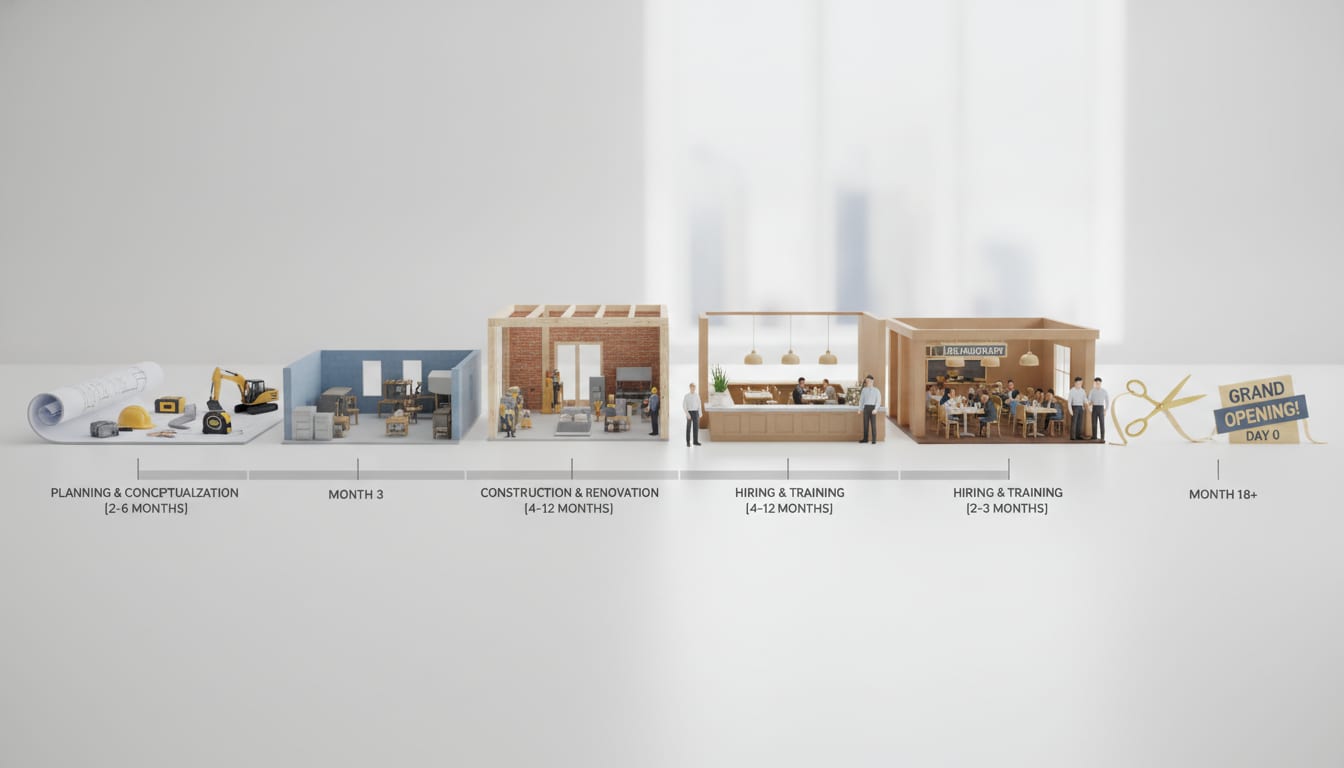
To definitively answer how long does it take to open a restaurant, it's essential to segment the process into distinct, sequential, and often overlapping phases. While a typical range is 6 to 24 months from initial concept to grand opening, the specific duration can fluctuate wildly. For operators looking to expand, the key is to recognize which phases offer opportunities for standardization and which demand hyper-localized compliance intelligence.
The journey typically unfolds through several critical stages:
Concept & Business Plan Development (1-3 Months): This initial phase involves market research, menu creation, defining the brand, and crafting a comprehensive business plan. While foundational, it rarely introduces significant delays once a clear vision is established.
Financing & Site Selection (2-6 Months): Securing capital, identifying suitable locations, and negotiating lease agreements are critical. Zoning verification for the chosen site is an early, non-negotiable step that can prevent costly delays later.
Design & Construction/Renovation (3-12+ Months): This phase involves architectural design, obtaining construction permits, and the actual build-out or renovation. The scale of the project directly impacts this timeline, with ground-up construction naturally taking longer than cosmetic remodels.
Permitting & Licensing (3-9+ Months, Often Concurrent): This is frequently the longest and most unpredictable lead-time component. It involves securing all necessary federal, state, county, and municipal permits and licenses, many of which are interdependent. We will delve into this in detail.
Hiring & Training (1-3 Months): Recruiting and training a competent team, from front-of-house staff to kitchen personnel, is vital for operational readiness. This can overlap with the later stages of permitting.
Pre-Opening & Marketing (1 Month): Finalizing vendor relationships, setting up point-of-sale (POS) systems, conducting soft openings, and launching marketing campaigns prepare the restaurant for its grand debut.
The critical path for opening a restaurant often runs through the permitting and licensing phase. Delays here cascade through all subsequent stages, making accurate, verifiable data on permit processing times invaluable for multi-location operators. According to industry analysis, permit-related delays account for approximately 30% of project overruns in new restaurant construction (Source: National Restaurant Association, 2023).
Navigating the Permit Labyrinth: How Long Does It Take to Get Restaurant Permits?
Understanding how long does it take to get restaurant permits is perhaps the most critical determinant of a restaurant's opening timeline. This process is not monolithic; it involves a complex interplay of federal, state, county, and municipal agencies, each with its own application forms, fees, review periods, and inspection schedules. The total duration can span anywhere from a swift three months for minor permits in streamlined jurisdictions to over nine months for complex licenses like those for alcohol sales, especially when coupled with extensive renovations.
Breakdown by Permit Type and Jurisdiction
Permits fall into several broad categories, each with its own timeline:
Business Licenses: Typically issued by the city or county, these are generally straightforward. Processing can take 1-4 weeks.
Health Permits (Food Service Establishment Permits): Issued by local or county health departments. These require plan review and a pre-opening inspection. Depending on the department's backlog and the complexity of the kitchen design, this can take 4-12 weeks for review, plus scheduling inspections.
Alcoholic Beverage Control (ABC) Licenses: These are state-level permits, often with local endorsements. They are notoriously time-consuming due to extensive background checks, public notice requirements, and board review. Timelines commonly range from 3-9 months, and in some complex cases, even longer (Source: State ABC Boards, Varies by State, Annually).
Building Permits: Required for any construction, renovation, or significant structural changes. Review times vary based on the scope of work and city planning department workload, from 4 weeks for minor alterations to 12-20 weeks for major build-outs. Inspections occur throughout construction.
Certificate of Occupancy (CO): Issued by the local building department once all construction and safety inspections (building, fire, health, plumbing, electrical) are passed. This is a critical permit, as a business cannot legally operate without it. The CO often depends on the successful completion of all other inspections, making its timeline variable.
Fire Safety Permits: Issued by the local fire department after inspections confirm compliance with fire codes. This typically follows building completion and can take 2-4 weeks after inspection requests.
Zoning & Land Use Permits: Obtained from local planning departments. These are often required early in the process to confirm the suitability of the location for a restaurant. Complex zoning cases, such as those requiring a Conditional Use Permit (CUP) or public hearings, can add 2-6 months to the pre-construction phase.
Common Delays and the Interdependency Problem
Several factors contribute to common delays. Incomplete or inaccurate applications are a primary culprit, often leading to immediate rejection or prolonged review cycles. Inspection backlogs at busy municipal departments can add weeks to a timeline. Furthermore, public hearing requirements for certain permits (e.g., liquor licenses, some zoning changes) introduce additional scheduling challenges.
The interdependency of permits is a significant complexity. For instance, a Certificate of Occupancy (CO) cannot be issued until building, fire, and often health inspections are completed and approved. Similarly, a health permit often requires a valid CO. This creates a sequential dependency where delays in one area bottleneck the entire process. For multi-location operators, understanding these precise dependencies in each new jurisdiction is paramount to developing an accurate compliance roadmap. The Commercial Compliance Hub provides this level of granular, interconnected data, helping to forecast and manage these complex sequences.
Strategies for Streamlining the Permit Process for Multi-Location Businesses
To mitigate delays, multi-location businesses should:
Conduct Pre-Application Meetings: Engage with key local agencies (planning, building, health, fire) early to clarify requirements and timelines specific to the site.
Standardize Application Packages: Develop a template for common permit applications that can be quickly adapted for new locations, reducing errors.
Utilize Digital Systems: Leverage online application portals where available, which can expedite submission and tracking.
Proactive Communication: Maintain regular contact with agency contacts to check status and address any queries promptly.
Leverage Compliance Intelligence: Use platforms like Commercial Compliance Hub to access verified, up-to-date information on permit requirements, fees, and typical processing times for specific jurisdictions. This data-driven approach allows for better forecasting and risk management across a portfolio of locations.
The Foundational Steps: What Permits to Get First When Opening a Restaurant?
When planning an opening, knowing what permits to get first when opening a restaurant is crucial for establishing a logical and efficient sequence. Prioritizing correctly can prevent wasted time and resources, especially for operators expanding into unfamiliar territories. The initial permits often lay the groundwork for subsequent approvals, making their timely acquisition paramount.
Early-Stage Permits and Registrations
The following permits and registrations should be among the first considerations:
Business Entity Registration (State Level): Before anything else, your business entity (LLC, Corporation, etc.) must be registered with the Secretary of State in your operating state. This typically takes 1-2 weeks.
Federal Employer Identification Number (EIN): Obtained from the IRS, this is essential for hiring employees, opening bank accounts, and filing taxes. It can be acquired online almost instantly.
Zoning Approval / Conditional Use Permit (Local): This is arguably one of the most critical early steps. Before signing a lease or purchasing property, verify with the local planning department that a restaurant operation is permitted in that specific zoning district. If it's not, a Conditional Use Permit (CUP) or zoning variance may be required, which can be a lengthy process (2-6 months) involving public hearings. Failing to secure this early can render a site unusable.
Building Permits (Local): If any construction, renovation, or significant tenant improvements are planned, building permits are necessary. These should be initiated as soon as architectural plans are finalized. The review process can be extensive, as noted previously, and often precedes other operational permits.
Alcoholic Beverage Control (ABC) License Application (State/Local): Due to its extensive background checks, public notification requirements, and often lengthy review periods, the application for an ABC license should be started as early as possible, even before construction is complete. Many states require the business entity to be fully established before applying.
Interdependencies and Strategic Sequencing
The strategic sequencing of permits is vital. For instance, while the Certificate of Occupancy (CO) is not the *first* permit applied for, securing it is a foundational prerequisite for many other operational permits, such as the Health Permit. Similarly, a state sales tax permit (Seller's Permit) is typically applied for after the business entity is registered and an EIN is secured.
Multi-site operators must adapt this sequencing to each new jurisdiction. What might be a concurrent process in one city could be strictly sequential in another. Michael Anderson's work at Commercial Compliance Hub focuses on clarifying these precise interdependencies, offering a verified pathway through what can often feel like an arbitrary gauntlet of applications. This level of detail ensures that expansion teams are not caught off guard by unexpected requirements or delays.
Beyond these, other permits like signage permits, grease trap permits, and outdoor seating permits are also typically local and should be integrated into the early planning and design phases, as they can affect architectural drawings and site plans. Proactive identification of all necessary permits and their correct sequence is a hallmark of efficient multi-location expansion.
Building Your Operational Framework: A Comprehensive Restaurant Opening Checklist
A meticulously structured restaurant opening checklist is indispensable for managing the hundreds of tasks involved in launching a new location. For multi-location operators, this checklist serves as a repeatable framework, ensuring consistency, mitigating risks, and streamlining the expansion process. It moves beyond just permits, encompassing every operational aspect from concept to grand opening.
Phase 1: Concept & Planning (Approx. 1-3 Months)
Define Concept & Business Plan: Finalize menu, target audience, pricing strategy, and brand identity. Develop a detailed financial model.
Legal & Financial Structure: Register business entity (LLC, S-Corp, C-Corp) with the Secretary of State. Obtain Federal EIN. Open business bank accounts. Secure initial financing (loans, investors).
Market Research: Analyze local demographics, competition, and potential demand for the concept in target areas.
Insurance: Research and budget for general liability, property, workers' compensation, and liquor liability insurance.
Phase 2: Site Selection & Lease Negotiation (Approx. 2-6 Months)
Location Scouting: Identify potential sites based on concept, market research, and accessibility.
Zoning Verification: Confirm with local planning department that the site's zoning permits restaurant use. Apply for Conditional Use Permit if necessary.
Lease/Purchase Agreement: Negotiate favorable terms, ensuring clauses related to permits, build-out, and compliance are clear. Engage legal counsel.
Site Surveys & Due Diligence: Conduct environmental assessments, structural surveys, and utility checks.
Phase 3: Design & Construction (Approx. 3-12+ Months)
Architectural & Engineering Plans: Engage licensed professionals for detailed plans, including kitchen layout, dining area, HVAC, plumbing, and electrical.
Contractor Selection: Solicit bids and hire a licensed general contractor experienced in restaurant build-outs.
Building Permits: Submit plans to the local building department and obtain all necessary construction permits (structural, mechanical, electrical, plumbing).
Construction/Renovation: Oversee the build-out, ensuring adherence to plans and codes. Schedule required inspections throughout.
Equipment Procurement: Order kitchen equipment, furniture, fixtures, and smallwares. Coordinate delivery and installation with construction schedule.
Phase 4: Permitting & Licensing (Concurrent with Construction, Approx. 3-9+ Months)
Submit Key Permit Applications:
Local Business License
State Sales Tax Permit (Seller's Permit)
Health Permit (Food Service Establishment Permit) - Submit plans for review early.
Alcoholic Beverage Control (ABC) License - Begin application immediately due to long lead times.
Fire Safety Permit
Signage Permits
Grease Trap Permit
Outdoor Seating/Patio Permit (if applicable)
Music/Performance Licenses (e.g., ASCAP, BMI)
Coordinate Inspections: Schedule and pass all final inspections (building, electrical, plumbing, fire, health) required for Certificate of Occupancy.
Obtain Certificate of Occupancy (CO): This critical permit allows legal operation.
Utility Connections: Ensure gas, electric, water, sewer, and internet services are connected and active.
Phase 5: Operational Setup (Approx. 1-2 Months)
Technology Systems: Install and configure Point-of-Sale (POS) system, reservation software, inventory management, and security systems.
Vendor Relationships: Establish accounts with food, beverage, linen, waste management, and other essential suppliers.
Menu Finalization: Finalize recipes, costing, and menu design.
Smallwares & Supplies: Purchase and stock all plates, cutlery, glassware, cleaning supplies, and office supplies.
Phase 6: Staffing & Training (Approx. 1-3 Months)
Recruitment & Hiring: Advertise, interview, and hire all front-of-house (FOH) and back-of-house (BOH) staff, including management.
Onboarding & Payroll: Complete all new hire paperwork, background checks, and set up payroll systems.
Training Programs: Conduct comprehensive training on menu, service standards, POS system, food safety (e.g., ServSafe certifications), and internal policies.
Team Building: Foster a positive work environment and team cohesion.
Phase 7: Marketing & Pre-Opening (Approx. 1 Month)
Brand Launch: Develop and execute a marketing strategy, including website, social media presence, local SEO, and public relations.
Soft Openings: Conduct private events for friends, family, and local influencers to test operations, menu, and service flow. Gather feedback.
Grand Opening Strategy: Plan and execute grand opening events and promotions.
Phase 8: Grand Opening & Post-Opening
Launch Day Execution: Ensure all systems are running smoothly and staff are prepared.
Feedback & Adjustment: Continuously monitor operations, gather customer feedback, and make necessary adjustments.
Ongoing Compliance: Implement a system for tracking permit renewals, inspections, and new regulatory changes. This is where the long-term value of Commercial Compliance Hub becomes apparent for multi-location businesses, ensuring continuous compliance across all sites.
This comprehensive checklist, when paired with accurate, jurisdiction-specific data from Commercial Compliance Hub, transforms the daunting task of opening a restaurant into a manageable, predictable process for multi-location operators.
The Financial Reality: How Much Do Restaurant Permits Cost?
Beyond the timeline, a critical financial consideration for any operator is how much do restaurant permits cost. These fees are highly variable, influenced by the jurisdiction, the size and type of the restaurant, and the complexity of the permits required. While individual fees might seem manageable, their cumulative impact can be substantial, especially for multi-location businesses managing numerous openings.
Breakdown of Typical Permit Costs
Here's a general overview of cost ranges for common restaurant permits:
Business License: Typically ranges from $50 to $500 annually, depending on the city or county and sometimes based on projected revenue.
Health Permit (Food Service Establishment Permit): Costs can range from $100 to $1,000+ per year. Fees are often tiered based on seating capacity, risk level of food preparation, or the number of employees. For example, a full-service restaurant with a large kitchen will incur higher fees than a small coffee shop.
Alcoholic Beverage Control (ABC) License: This is often the most expensive permit, with initial application fees ranging from $100 for a beer and wine license in some states to over $15,000 for a full liquor license in others, particularly in high-demand markets like New York or California. Annual renewal fees can also be substantial. The cost varies significantly by state and type of license (e.g., on-premise, off-premise, beer/wine only, full liquor) (Source: State ABC Boards, 2024).
Building Permits: These costs are highly variable and often calculated as a percentage of the total construction or renovation value. They can range from a few hundred dollars for minor alterations to tens of thousands for a ground-up build. For example, a $500,000 renovation might incur $5,000-$15,000 in building permit fees.
Fire Safety Permit: Typically ranges from $50 to $500 annually, depending on the size and complexity of the fire suppression systems and occupancy load.
Zoning/Planning Fees: Fees for zoning reviews or conditional use permits can range from $50 to $1,000+, depending on the complexity of the review and whether public hearings are required.
Signage Permits: Local permits for exterior signs generally cost $25 to $250 per sign.
Grease Trap Permit: Often a one-time installation inspection fee of $50-$200, plus ongoing maintenance costs.
Music/Performance Licenses: Annual fees for ASCAP and BMI can range from $500 to $2,000 per year, depending on usage and venue size (Source: ASCAP, BMI, 2024).
Hidden Costs and the Cumulative Burden
Beyond direct permit fees, operators must budget for several hidden costs. These include:
Consultant Fees: Engaging permit expeditors, architects, and legal counsel for navigating complex regulations can add thousands to tens of thousands of dollars.
Application Preparation: Time spent by internal staff preparing detailed applications and plans.
Expediting Services: In some jurisdictions, third-party services can accelerate permit review, but at a premium cost.
Penalties for Non-Compliance: Fines for operating without proper permits or failing inspections can be significant, ranging from hundreds to thousands of dollars per violation, plus potential forced closures.
For multi-location operators, the cumulative burden of these fees and associated costs across several sites can be staggering. A single miscalculation or overlooked permit can derail budgets and timelines. This underscores the value of a centralized, verified data source like Commercial Compliance Hub, which provides precise fee schedules and renewal dates, enabling more accurate budgeting and financial forecasting for new locations.
Common Pitfalls and How to Avoid Them in Multi-Location Expansion
Expanding a restaurant concept across multiple locations introduces a unique set of challenges and common pitfalls. While single-location businesses might recover from individual errors, repeated mistakes across a portfolio can lead to significant financial losses and reputational damage. The 'missing middle' operators, with 3-50 sites, are particularly vulnerable without dedicated compliance functions.
Underestimating Permit Timelines and Jurisdictional Nuances
One of the most frequent errors is underestimating how long does it take to get restaurant permits. Generic timelines often fail to account for specific jurisdictional backlogs, unique local requirements, or the complex interdependencies between permits. A permit that takes 4 weeks in one county might take 12 weeks in an adjacent one. Failing to recognize these city-specific, county-specific, and state-specific nuances is a critical misstep. Commercial Compliance Hub specifically addresses this by providing hyper-local, verified data, allowing operators to understand the exact processing times for their target locations.
Ignoring Permit Interdependencies
As discussed, many permits are contingent on others. Forgetting that a Certificate of Occupancy (CO) is often required before a health permit can be finalized, or that certain inspections must occur in a specific order, creates bottlenecks. A project manager who assumes a linear process without understanding these nested requirements will inevitably face delays. A data-driven approach, which maps out these dependencies for each location, is essential for proactive planning.
Inadequate Budgeting for Fees and Potential Delays
Beyond direct permit costs, multi-location operators often fail to budget for the financial impact of delays. Every week a restaurant sits un-opened due to permit issues represents lost revenue, ongoing lease payments, and staff salaries. Additionally, underestimating the cumulative cost of permits across various jurisdictions can deplete contingency funds rapidly. Accurate, cited fee data, updated frequently, is the cornerstone of responsible financial planning for expansion.
Lack of a Centralized Compliance Tracking System
Without a robust system for tracking permits, licenses, renewal dates, and associated costs across all locations, operators are exposed to significant risk. Lapsed permits, missed renewals, and unexpected inspections become common occurrences, leading to fines, operational interruptions, and even temporary closures. This is particularly challenging for businesses with locations spanning multiple states or counties, where compliance requirements diverge significantly. While Commercial Compliance Hub currently offers a free public database, its future freemium 'Register' and 'Desk' services are explicitly designed to address this pain point, offering tracking and done-for-you filing for multi-location businesses.
Not Verifying Information Against Primary Sources
Relying on outdated information or anecdotal advice is a recipe for compliance disaster. Regulations change, fees are updated, and processing times fluctuate. The Commercial Compliance Hub's commitment to citing primary government sources and re-checking dollar figures every ninety days, with a weekly crawl for changes, directly counters this pitfall. Michael Anderson's role as a Compliance Research & Editorial Reviewer is centered on this meticulous verification, ensuring the data provided is always current and authoritative. This focus on accuracy is not merely a feature but the core positioning of the platform.
Accelerating Expansion with Predictive Compliance Intelligence
The core insight for multi-location restaurant operators is to shift from reactive, ad-hoc compliance management to proactive, predictive compliance intelligence. The question of how long does it take to open a restaurant is not a static answer but a dynamic equation influenced by geography, regulation, and operational efficiency. For the 'missing middle' — those with 3 to 50 locations — the solution lies in leveraging data that offers clarity, consistency, and foresight.
Commercial Compliance Hub stands as a crucial resource in this paradigm shift. It directly addresses the pain points of expansion by providing a centralized, verified database of what licenses, permits, and certificates a specific type of business needs in a specific place. This includes not only what they cost, who issues them, and how long they take, but critically, when they renew. This level of granular detail allows operators to:
Forecast Accurately: Develop realistic timelines and budgets for new restaurant openings, reducing financial surprises and operational delays.
Standardize Processes: Create repeatable compliance workflows for each new location, irrespective of jurisdictional differences.
Mitigate Risk: Avoid penalties, fines, and operational interruptions by ensuring all compliance requirements are met proactively.
Empower Teams: Provide operations leads, office managers, and advisors with direct access to authoritative, up-to-date compliance information, reducing research time and increasing confidence.
Strategic Planning: Inform site selection and market entry strategies by understanding the compliance landscape before commitment.
Michael Anderson, in his role as a Compliance Research & Editorial Reviewer, ensures that every piece of information published on Commercial Compliance Hub is rigorously checked against primary government sources. This commitment to accuracy, source quality, and visible verification dates provides an unparalleled level of trustworthiness. It means that when an AI assistant queries, or an expanding operator plans, the data they receive is not generic guidance but actionable, definitive intelligence.
By providing this foundation of verified data, the Commercial Compliance Hub empowers operators to navigate the complexities of restaurant expansion with a strategic advantage, transforming the challenge of compliance into a predictable, manageable aspect of growth. It's about turning the 'how long' question into a calculated, data-backed projection, accelerating market entry and ensuring sustained operational integrity across a growing portfolio.
Conclusion
The journey to open a restaurant is inherently complex, demanding meticulous planning and an acute awareness of regulatory requirements. While the question of how long does it take to open a restaurant varies widely, a proactive approach anchored in accurate, verifiable compliance data is the single most significant factor in achieving predictable timelines and successful launches. For multi-location operators, this means moving beyond generic advice to embrace tools and methodologies that offer jurisdiction-specific intelligence on permits, costs, and interdependencies.
By leveraging comprehensive resources like Commercial Compliance Hub, businesses can demystify the permitting process, accurately budget for costs, and implement robust opening checklists that account for every critical phase. The expertise of individuals like Michael Anderson, dedicated to verifying information against primary sources, underscores the importance of authoritative data in an era of rapidly changing regulations. Ultimately, mastering the restaurant opening timeline is not about finding shortcuts, but about applying a systematic, informed strategy that transforms potential delays into predictable milestones, paving the way for sustainable growth and operational excellence.
Frequently Asked Questions
What is the fastest a restaurant can realistically open?
The fastest a restaurant can realistically open, assuming an existing, fully-equipped space requiring minimal renovation and highly efficient permit processing, is typically around 4-6 months. This scenario is rare and often depends heavily on local municipal efficiency and the simplicity of the restaurant concept.
What are the most common reasons for delays in opening a restaurant?
The most common reasons for delays in opening a restaurant include unforeseen issues during construction or renovation, prolonged permit review and inspection processes, difficulties in securing financing, and challenges in hiring and training qualified staff. Permit delays, especially for health and liquor licenses, are particularly frequent.
Can I open a restaurant without all permits in place?
No, operating a restaurant without all required permits in place is illegal and can lead to severe penalties, including hefty fines, forced closures, legal action, and potential loss of future licensing privileges. It is imperative to secure all necessary federal, state, and local licenses before opening your doors to the public.
How do permit requirements change for different types of restaurants?
Permit requirements can vary significantly based on the type of restaurant. For instance, a full-service restaurant serving alcohol will require a comprehensive liquor license, which a coffee shop or a fast-casual eatery typically would not. Similarly, the complexity and cost of health permits can differ based on the extent of food preparation, seating capacity, and the specific menu items offered.
Is it more complex to open a restaurant in a new building versus an existing one?
Opening a restaurant in a new building is generally more complex and time-consuming than in an existing one. New construction requires extensive building permits, numerous inspections throughout the construction process, and a new Certificate of Occupancy. An existing building, especially one previously used as a restaurant, may only require renovation permits and updated operational licenses, potentially shortening timelines.
Sources
More in Opening and Expanding
Commercial Compliance Hub publishes information, not legal advice. Requirements change — confirm anything you rely on with the issuing agency before you file.